

You saved enough to feel ready, but not enough to feel confident. The mortgage aisle is full of acronyms that all sound the same until one of them saves you $40,000 in interest.
First-time homebuyer loans are not interchangeable, and picking the wrong one is a real and avoidable mistake.



I genuinely disagree with the advice that says "just get pre-approved and figure out the program later." Choosing your loan type before you choose your house changes which neighborhoods are realistic for you.
The four programs covered here are FHA, VA, USDA, and state-level down payment assistance. Each targets a different financial situation. Two of them require zero down payment.
FHA Loans: The Program Everyone Mentions, But Few Fully Understand
FHA loans are insured by the Federal Housing Administration. They are not issued by the government directly.
A private lender makes the loan, and the FHA covers the lender if you default. That distinction matters because your experience depends heavily on which lender you choose, not just the program rules.
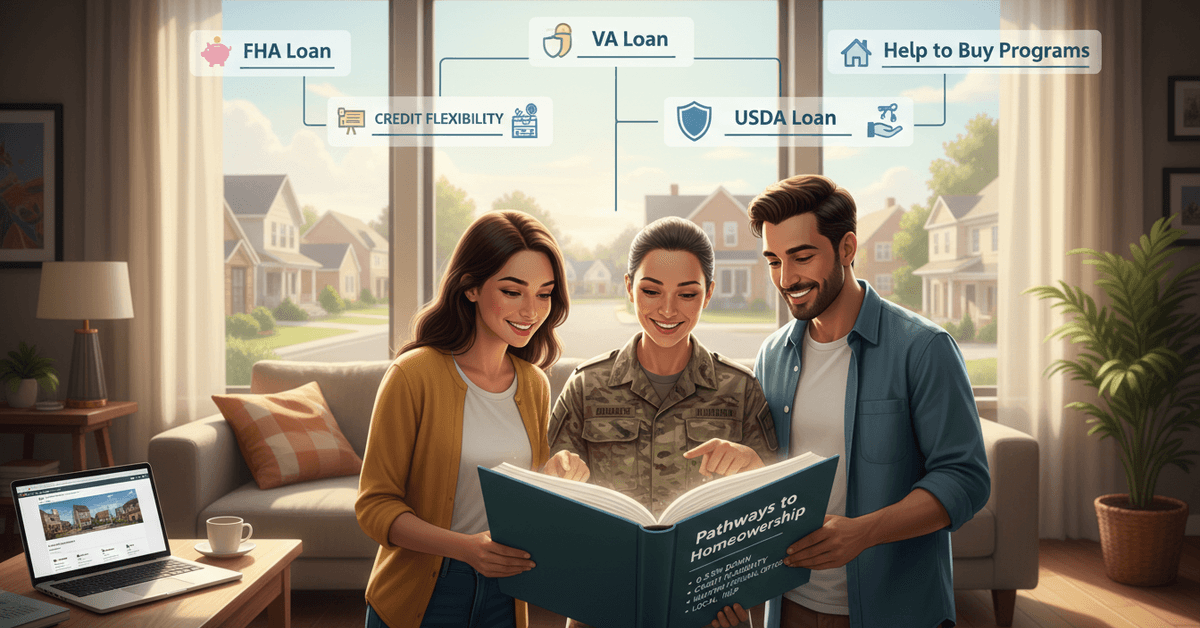
The minimum down payment is 3.5% if your credit score is 580 or above. Drop below 580, and the requirement jumps to 10%. That 80-point gap affects a lot of buyers who think they qualify when they are just below the threshold.
What makes FHA loans worth considering
- Accepts higher debt-to-income ratios than most conventional loans
- Available through lenders nationwide, not just specific banks
- Allows gifted funds for both the down payment and closing costs
- Credit floor sits at 500, which few loan types match
The cost most buyers underestimate
Mortgage insurance premiums (MIP) are required on FHA loans. There is an upfront premium of 1.75% of the loan amount, plus an annual premium charged monthly. On a $300,000 loan, that upfront premium is $5,250.
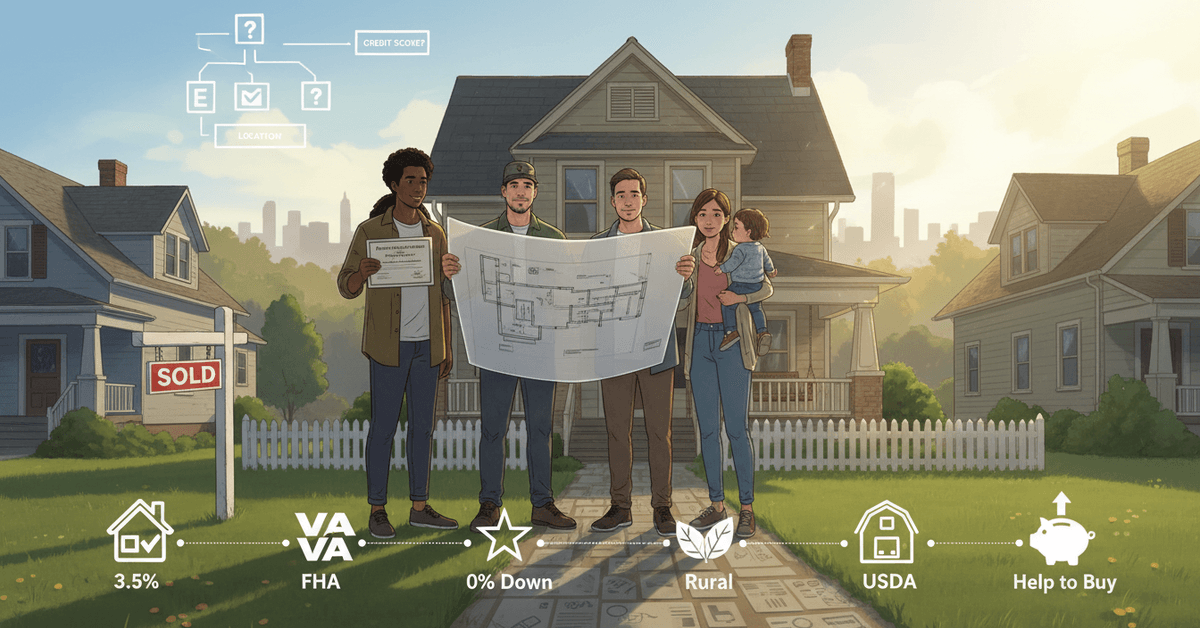
For many buyers, that math still beats saving an extra 10% to avoid it. But I think the mistake is treating MIP as a flat unavoidable fee.
Some lenders price their rates differently to offset it. Comparing at least three lenders on the same FHA program is worth the two hours it takes.
VA Loans: The Best Loan Option Available, and Many Eligible Buyers Skip It
I'll be direct: if you served and you qualify for a VA loan, this is almost certainly the best mortgage product available to you. No down payment required. No private mortgage insurance. The Department of Veterans Affairs backs the loan, and lenders compete hard for VA borrowers.
Eligibility extends to:
- Active-duty service members
- Veterans who meet minimum service requirements
- Certain National Guard and Reserve members
- Some surviving spouses
The fees buyers don't always see coming
There is a VA funding fee, which ranges based on your down payment and whether you have used the benefit before.
First-time users putting 0% down pay 2.15% of the loan amount as of 2026 rates. That can be rolled into the loan rather than paid upfront, but it adds to your balance.
Veterans with a service-connected disability rating of 10% or higher are exempt from the funding fee entirely. That exemption is worth confirming before closing.
VA appraisals run stricter than conventional ones
VA appraisers check minimum property requirements that conventional lenders ignore. Peeling paint, missing handrails, roof issues: all can delay or kill a deal. This is not a dealbreaker, but it is a negotiation point.
Sellers in competitive markets sometimes resist VA offers because of this. I think that bias is fading in 2026, but it is still a real friction point in some regions.
USDA Loans: Zero Down, and the Eligible Map Is Larger Than You Think
USDA home loans come from the U.S. Department of Agriculture and are aimed at buyers purchasing in designated rural and semi-rural areas. The program offers 0% down payment. Income limits apply, set by region and household size.
The perception that USDA loans only work for farms or remote land is wrong. Many outer suburbs and small towns fall inside USDA-eligible boundaries. A ZIP code lookup on the USDA eligibility map takes about 30 seconds and often surprises buyers.
USDA loan requirements at a glance
- Property must be in a USDA-eligible area
- Household income must fall within regional limits
- Credit score around 640 is the general benchmark most lenders use
- Mortgage insurance is required, but rates run lower than FHA
Processing can run slower than conventional loans because of agency review steps. Budget an extra two to four weeks into your closing timeline if you go this route.
Down Payment Assistance Programs: Stacking Help You Didn't Know Was Available
Federal loan programs cover a lot of ground, but state and local down payment assistance programs fill the gaps that federal rules leave open.
These go by different names depending on the state. Some are called "Help to Buy" programs. Others are structured as grants, forgivable loans, or deferred-payment second mortgages.
The core offer is usually one of these:
- Grants that do not need to be repaid if you stay in the home a set number of years
- Forgivable second mortgages that disappear after a holding period, often five to ten years
- Closing cost assistance layered on top of an FHA or USDA loan
- Homebuyer education credits tied to completing a counseling course
I was skeptical that stacking a state grant on top of an FHA loan was actually allowed, but the HUD-approved housing counseling agency directory lists programs by state and clarifies exactly what can be combined.
Many buyers leave thousands on the table because they applied for federal help without checking what their city or county also offers.
What changes year to year
Funding availability shifts annually. Some programs exhaust their allocation by spring. Applying early in the calendar year, usually January through March, increases your odds of hitting active funding before it runs out.
Comparing the Four Programs Side by Side
| Program | Down Payment | Credit Score | Mortgage Insurance | Special Requirement |
|---|---|---|---|---|
| FHA | 3.5% minimum | 580+ | Yes (MIP) | None |
| VA | 0% | Flexible | No PMI | Military service record |
| USDA | 0% | ~640 | Yes (low rate) | Rural area + income cap |
| Down Payment Assistance | Varies | Varies | Depends on base loan | State/program-specific |
The table looks clean, but the real decision comes down to location and service history. VA wins on monthly cost for eligible buyers. USDA wins on access for rural buyers with moderate income. FHA wins on geographic and credit flexibility.
What to Sort Out Before You Apply
Down payment capacity is the first filter. If saving 3.5% is realistic, FHA is a practical start. If 0% is the only path that works, narrow to VA or USDA based on your background and address.
Credit health is the second filter. Scores in the 580 to 620 range narrow your options. Spending 6 to 12 months paying down revolving debt before applying can open up better rate tiers.
Location is the third, and many buyers check it last. USDA eligibility, VA property standards, and local assistance program boundaries all depend on where the house sits, not just where you live now.
Long-term affordability is easy to ignore when you are excited about a house. A $250 monthly difference in payment adds up to $90,000 over 30 years. The loan type you choose on day one sets that number.
Questions People Ask About First-Time Homebuyer Loans
Q: Can I use a VA loan and down payment assistance at the same time? Some states allow layering VA loans with local assistance programs, particularly for closing costs. Confirm directly with a HUD-approved counselor in your state before assuming it is permitted.
Q: Do USDA loans work for condos or townhomes? USDA loans are generally limited to single-family homes in eligible rural areas. Condos and multi-unit properties are typically excluded, though exceptions exist for specific approved developments.
Q: How long does FHA mortgage insurance last? For loans where the down payment was less than 10%, MIP stays on the loan for its full term. Putting 10% or more down at closing reduces the MIP duration to 11 years. Refinancing to a conventional loan later is one way to drop it.
Q: Is it harder to get a seller to accept a VA offer? Some sellers worry about VA appraisal requirements adding delays or repair demands. Writing a clean offer with flexible closing dates tends to offset that concern. The bias is real but negotiable.
Q: What credit score do I actually need for a USDA loan? Most lenders want to see at least a 640 score for USDA approval, though the program technically has no official minimum. Lender overlays are stricter than the government guidelines in most cases.
Conclusion
Picking a first-time homebuyer loan without comparing all four programs is like choosing a flight without checking departure times. FHA, VA, USDA, and local assistance programs each carry different costs that compound over decades.
Run the real numbers on two or three options before you fall in love with a house. The loan type you choose shapes your monthly budget for the next 30 years.